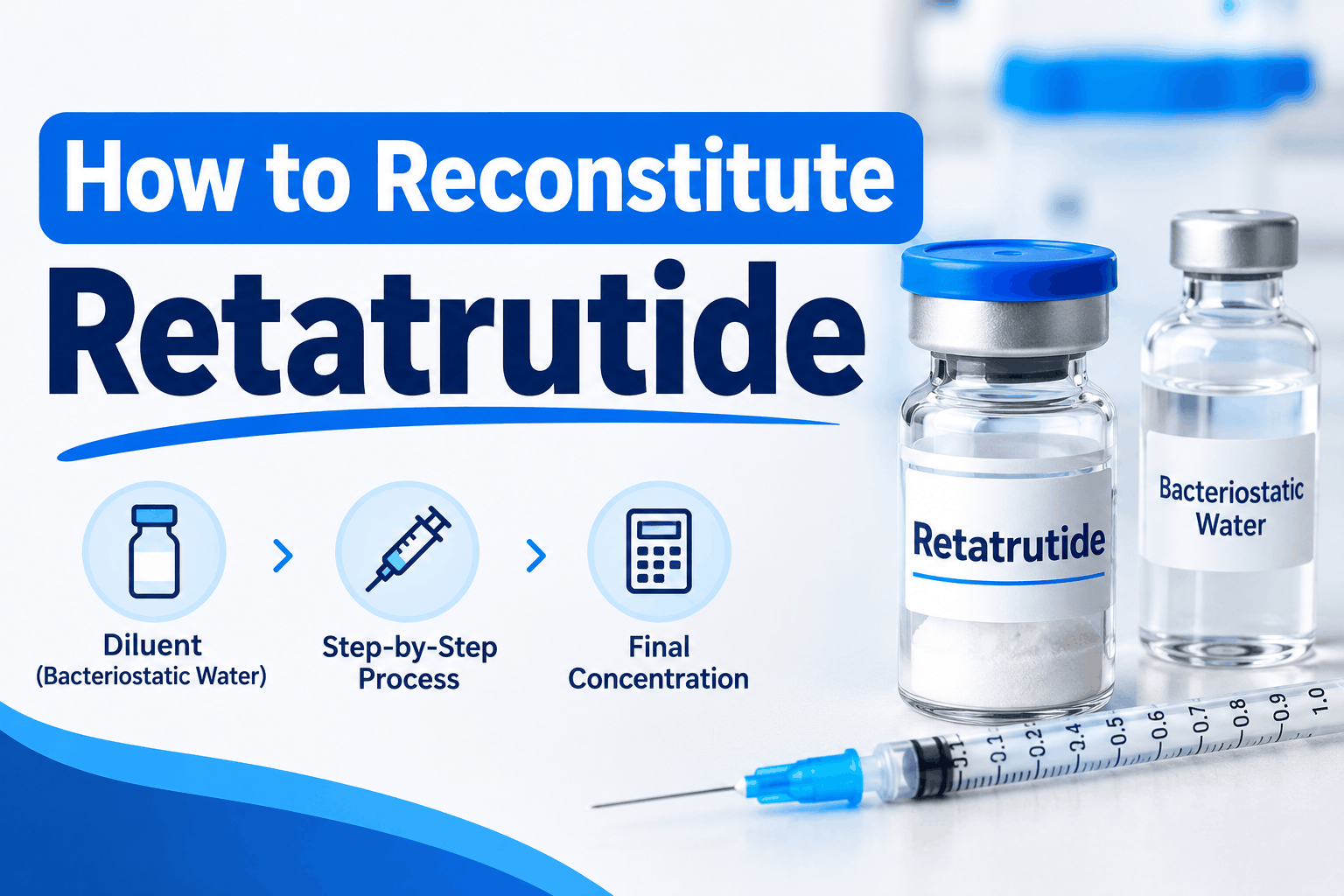
How to Reconstitute Retatrutide
Learn what reconstitution means, how mg, mcg, and mL relate to each other, and why retatrutide is still an investigational medicine. It also explains what 5 mg, 10 mg, 20 mg, and 50 mg vial labels mean. This guide explains terminology and measurement concepts only. It does not provide preparation or dosing instructions.
Quick Answer
People searching for how to reconstitute retatrutide are usually trying to understand a mix of unfamiliar terms: peptide mass, concentration, dilution, and reconstitution. Online forums use these words loosely, and sometimes interchangeably, which creates real confusion.
This article does not give a retatrutide preparation method, and you should not rely on any website for one. Retatrutide is an investigational medicine, and there is no approved label that tells anyone how to prepare it. What this guide can do is explain what the terms mean, how the units relate, and why a calculator cannot answer safety questions.
What Is Retatrutide?
Retatrutide is an experimental medicine developed by Eli Lilly. It is described as a “triple agonist,” meaning it is designed to activate three hormone receptors involved in appetite and metabolism: GIP, GLP-1, and glucagon. This is how the original phase 2 obesity trial published in the New England Journal of Medicine described it.
Since then, the drug has moved into phase 3 studies. Lilly reported results from two further trials, TRIUMPH-2 and TRIUMPH-3, in a press release dated 23 July 2026, and a phase 3 report has also appeared in the New England Journal of Medicine in 2026. Company announcements and trial results are not the same as regulatory approval.
Lilly stated that it plans to submit a Biologics License Application (BLA) to the FDA in the first quarter of 2027. A submission is a request for review. It is not an approval, and the outcome is not known.
Is Retatrutide Approved for Weight Loss?
No. As of 19 October 2026, retatrutide is not an FDA-approved medicine. Lilly itself describes it as “an investigational molecule that cannot be legally sold or marketed for human use.”
The FDA has also addressed products sold online. Its page on unapproved GLP-1 drugs says the agency has warned companies selling retatrutide, semaglutide, and tirzepatide products labeled “for research purposes” or “not for human consumption,” and that retatrutide cannot be used in compounding under federal law. The FDA notes that the quality of such products is unknown.
In short, a “research-grade” vial is not an approved medicine, and its label does not prove what is inside.
What Does Reconstitution Mean?
In general science, reconstitution means restoring a dried or concentrated substance to a liquid form by adding a liquid. Many peptides are supplied as freeze-dried (lyophilized) powder because they are more stable that way. Turning the powder back into a solution is what “reconstitution” refers to.
Two related terms are often mixed up with it:
- Dilution: adding more liquid to a solution that already exists, which lowers its concentration.
- Concentration: how much substance is present per unit of liquid.
Understanding these definitions is not the same as knowing how to handle a specific product. Choices about liquids, quantities, sterility, and storage depend on verified product documentation and the setting in which a medicine is used. For an investigational drug, those decisions belong to an authorized research team or a licensed clinician, not to an online guide.
Why Do Concentration and Measurement Units Matter?
Most confusion in online peptide discussions comes from three different kinds of measurement being treated as one:
- Mass: how much substance there is, in milligrams (mg) or micrograms (mcg).
- Volume: how much liquid there is, in milliliters (mL).
- Concentration: the amount of substance per unit of liquid, such as mg/mL or mcg/mL.
The basic relationship is:
Concentration = Mass ÷ Volume
Mass units also convert in fixed steps: 1 mg = 1,000 mcg. So a value of 2.5 mg is the same amount as 2,500 mcg. Mixing up these two units creates an error of a thousand times, which is why unit discipline matters in any scientific calculation. For a deeper look at these conversions, see our guide to a peptide calculator in mg.
Keep one point clear: this arithmetic describes numbers. It does not tell you what amount is appropriate for any person, and it does not confirm that a product contains what its label says.
Retatrutide 5 mg, 10 mg, 20 mg, and 50 mg Vials: What the Label Number Means
People often search for terms such as “how to reconstitute retatrutide 5 mg,” “10 mg,” “20 mg vial,” or “50 mg.” These searches usually start from the same place: a number printed on a vial. It helps to understand what that number is, and what it is not.
On a vial label, a figure such as 5 mg, 10 mg, 20 mg, or 50 mg is normally the total mass of substance the seller claims is inside. It is not a concentration, because no liquid volume is involved yet. It is also not a dose and not an instruction.
- A 5 mg label and a 10 mg label describe different total masses, not different strengths per mL.
- A 20 mg vial and a 50 mg vial differ in the same way: in the total mass claimed, not in how they should be handled.
- Concentration (mg/mL) only exists once a mass is combined with a specific volume of liquid, as in Concentration = Mass ÷ Volume.
Vials offered online in these sizes are not FDA-approved medicines, because retatrutide itself is not approved. The FDA says the quality of such products is unknown, and no arithmetic can confirm that a vial contains what its label claims. That takes independent laboratory analysis.
For that reason, there is no approved instruction for how to reconstitute a retatrutide 5 mg, 10 mg, 20 mg, or 50 mg vial, and this guide does not give one. The vial size changes the numbers in a calculation, but it does not change the safety questions behind it.
Can an Online Retatrutide Calculator Tell You How to Reconstitute It?
No. A calculator can divide and convert units correctly, but it can only work with the numbers you type in. It cannot check:
- Whether the product is really retatrutide
- Whether it is pure, sterile, or stable
- Whether the label is accurate
- Whether the product is suitable for any individual
- What approved instructions exist, because none exist for retatrutide
A general concentration tool, such as our HGH 191AA calculator, shows how mass-to-volume math works. It is not designed for retatrutide, and no calculator on this site determines doses or preparation steps. If you are looking at weight-loss-related calculator searches, our page on a peptide calculator in mg for weight loss explains the same limits in more detail.
Retatrutide Safety and Research Considerations
Investigational medicines are studied under defined protocols for a reason. Trial participants are screened, monitored, and given material made under controlled quality standards. Researchers track side effects and report them, and regulators review the full evidence before approval.
Results from a trial describe what happened to specific participants under specific conditions. They do not show that the same outcome applies to a person using an unverified product outside a study. Long-term safety also cannot be assumed while studies are ongoing.
For this reason, this article does not discuss amounts, schedules, mixing quantities, liquids, or injection technique. Anyone with questions about an investigational medicine should speak with a licensed healthcare professional or an authorized clinical research team.
Retatrutide vs. Other Weight-Loss Medications
Semaglutide and tirzepatide are different medicines. Semaglutide acts on the GLP-1 receptor. Tirzepatide acts on both the GIP and GLP-1 receptors. Retatrutide is designed to act on GIP, GLP-1, and glucagon receptors.
Semaglutide and tirzepatide are available as FDA-approved prescription medicines with their own labeling, while retatrutide is not. They are not interchangeable, and their amounts cannot be compared as though they were equivalent. Never substitute one for another without direction from a prescriber.
Common Measurement Mistakes
These conceptual errors appear often in online discussions:
- Confusing mg with mL. Milligrams measure mass; milliliters measure liquid volume.
- Treating mg and mcg as interchangeable. They differ by a factor of 1,000.
- Assuming the mg on a vial is a dose or a concentration. It is the total mass claimed in the vial; concentration needs a liquid volume, and a dose is a medical decision.
- Assuming two products share the same concentration. Concentration depends on both the amount of substance and the amount of liquid.
- Assuming a calculator verifies a label. It only processes the numbers you give it.
- Treating a calculated number as a medical recommendation. A correct result is still only arithmetic.
Frequently Asked Questions
How do you reconstitute retatrutide?
Retatrutide is investigational, so there is no approved preparation instruction to follow. In general, reconstitution means dissolving a dried substance in a liquid, but the details for any product must come from verified documentation. Do not rely on online instructions. Consult a licensed healthcare professional or an authorized research team.
How do you reconstitute retatrutide 5 mg, 10 mg, 20 mg, or 50 mg vials?
There is no approved instruction for any vial size, because retatrutide is investigational. The mg figure on a label is the total mass claimed in the vial, not a concentration or a dose. Do not rely on online instructions to prepare these products. Consult a licensed healthcare professional or an authorized research team.
Is retatrutide approved by the FDA?
No. As of 19 October 2026, retatrutide is not FDA-approved. Eli Lilly has said it plans to submit a Biologics License Application in the first quarter of 2027, but a submission does not guarantee approval or its timing.
What does retatrutide concentration mean?
Concentration is the amount of substance per unit of liquid, usually written as mg/mL or mcg/mL. It is calculated as mass divided by volume. It describes a mathematical relationship and says nothing about whether a product is genuine, safe, or appropriate for a person.
What is the difference between mg and mL?
Milligrams (mg) measure mass, the amount of a substance. Milliliters (mL) measure volume, the amount of liquid. They are different properties and cannot be swapped. A concentration such as mg/mL combines the two.
Can a peptide calculator determine a retatrutide dose?
No. A calculator can convert units and divide mass by volume, but it cannot establish a dose, confirm a product’s identity or purity, or replace medical supervision. Questions about amounts for an investigational medicine belong with a clinician or authorized research team.
Is retatrutide the same as tirzepatide?
No. Tirzepatide is an approved prescription medicine acting on GIP and GLP-1 receptors. Retatrutide is investigational and is designed to act on GIP, GLP-1, and glucagon receptors. They are different molecules and should not be treated as interchangeable.
Where can I find reliable retatrutide research information?
Start with the FDA’s page on unapproved GLP-1 drugs, peer-reviewed papers on PubMed, and registered studies on ClinicalTrials.gov. Company press releases are useful but should be read alongside independent sources.
Conclusion
Searching for how to reconstitute retatrutide leads to a topic where the terminology is easy to learn and the practice is not something an online article can responsibly teach. Reconstitution means returning a dried substance to liquid form. Mass and volume are separate measurements, linked by the simple formula concentration = mass ÷ volume. And calculators, however accurate, only process the numbers entered into them.
Because retatrutide is still investigational, reliable information comes from regulators, peer-reviewed research, registered trials, and qualified clinicians, not from sellers or forum posts.
Disclaimer: This article is for educational purposes only. It is not medical advice, does not provide preparation, dosing, or administration instructions, and must not be used to decide any individual’s treatment. Retatrutide is an investigational medicine, and its regulatory status and applicable legal requirements should be respected. For medical questions, consult a qualified healthcare professional, and refer to official research and regulatory sources such as the FDA and ClinicalTrials.gov.